
TWO LEFT FEET
A NOTE ON ISLAMOGAUCHISME

When I studied history—alongside my main field of philosophy—I took a course called Global History. The course dealt less with events than with the historiography of world history: with how history itself is written. On the reading list was the influential book by J. M. Roberts, A History of the World, nearly five hundred pages long. At one point the historian traced the origin of the political terms left and right. Their birth, we were shown, was historically contingent, almost accidental. Their meanings were neither philosophically precise nor conceptually deep, yet over time they hardened into global political abstractions. In their most general form, they remain telling in their simplicity: the left is associated with progress, rupture, the new; the right with conservation, preservation, and the defense of inherited order. This rough opposition—progressive versus conservative—still structures much of our political imagination.
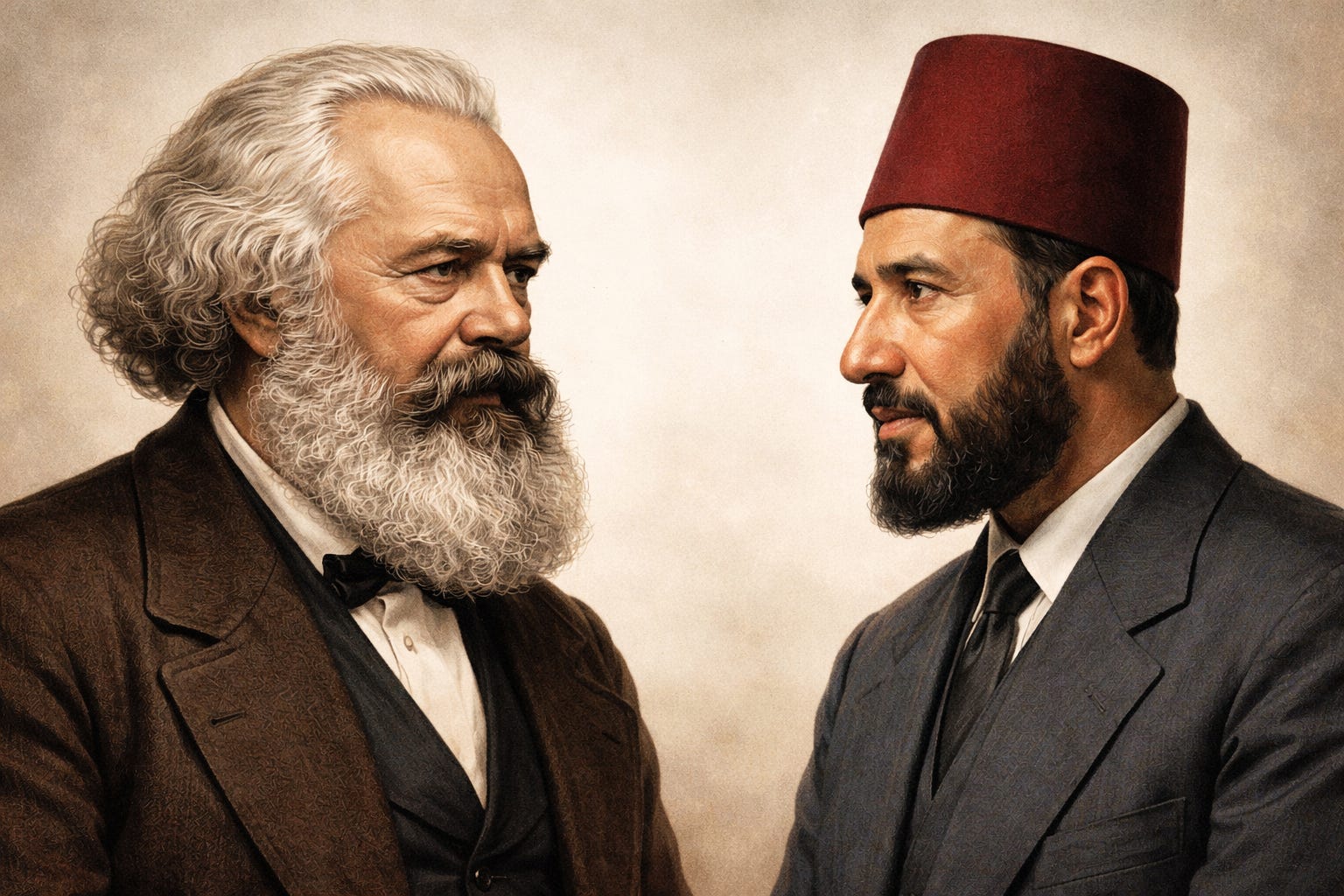
Against this backdrop, the contemporary phenomenon of “alliance” “sympathy” or “intellectual proximity” between parts of the Western left and Islamist movements appears not only strange but internally contradictory.
Indeed, these political movements do share certain enemies: imperialism, global capitalism, and geopolitical domination. Yet what the left often fails—or refuses—to confront is the deeper irony of this convergence: while the left fights the political right at home, it’s lending legitimacy to a different right—an Islamic right—abroad, and increasingly also within Western societies.
This paradox is rarely confronted directly. I suspect this is partly due to the way Islam and the Islamic world exist in the Western imagination: distorted and caricatured, flattened into symbols of either victimhood or menace and rarely understood as internally diverse political and intellectual landscapes.
Thus a strange optical illusion emerges. Islamists appear left-wing when viewed through the lens of Western power conflicts, yet remain fundamentally right-wing within their own social, moral, and political universe. Sunni Islamism orbits the concept of al-siyāsa al-sharʿiyya, while Shiʿi Islamism revolves around the idea of wilāyat al-faqīh. Both concepts have deep theological roots, reaching back to the beginnings of Islamic political theology and their sole aim is the protection of “God’s religion,” not the creation of a just political order.
It’s precisely there—in their own intellectual production—that the contradiction becomes undeniable.
Islamist thinkers have, for decades, engaged in sustained and often sophisticated critiques of the West: of modernity, liberalism, secularism, individualism, and imperial power. Many of these critiques are sharp, sometimes even shattering. But what the Islamist ultimately seeks through this critique is not what the left seeks at all. Their visions of society are not merely different; they are fundamentally opposed.
Where the left fights for emancipation from tradition, the Islamist seeks its absolutization.
Where the left defends individual autonomy, the Islamist demands moral submission.
Where the left dreams of equality, the Islamist insists on divinely ordained hierarchy.
This is the unresolved tension—perhaps the central blindness. Too many leftists engage not with Islamist theory, jurisprudence, and political theology, but with interviews, soundbites, and media performances by militant movements such as Hezbollah or Hamas. The result is a politics of projection: Western fantasies laid atop actors whose internal logic remains unthought.
On the social level, the situation becomes even more emotionally charged. Many self-proclaimed leftists arrive at sympathy for Islamists indirectly, through sincere solidarity with ordinary Muslims who are too often caught in the crossfire of right-wing polemics and civilizational alarmism. Faced with genuine racism and suspicion directed at Muslim communities, the left reflexively shields those it perceives as the persecuted subject.
Yet this protective reflex easily slides into ideological confusion. In defending Muslims from collective stigmatization, it begins—quietly, sometimes unconsciously—to excuse, relativize, or normalize Islamist political projects. The humanitarian impulse collapses into political indulgence.
In the modern Arab world the left did not encounter political Islam as an idea only, but as a force. Their encounters were born of urgency, not conviction. In Egypt, the Muslim Brotherhood and the Free Officers briefly converged after 1952, united against monarchy and British power, before Gamal Abdel Nasser turned the machinery of the state against Hassan al-Banna’s heirs, imprisoning and executing them by 1954. What appeared as revolutionary unity dissolved the moment ideological coherence was demanded.
In Algeria, the FLN wove Marxist language and Islamic symbolism together during the war of liberation (1954–1962). Frantz Fanon stood alongside ulema whose world he did not share. Independence exposed the fracture: socialism ruled the state, Islam endured in society and the deferred conflict returned decades later in blood - la décennie noire, the Black Decade.
In Palestine, George Habash’s Marxists and the Islamists of Hamas fought the same occupation, yet by the late 1990s the secular left had been hollowed out—its vocabulary absorbed, its organizations eclipsed by a movement that rejected its premises.
In Lebanon, the Communist Party fought alongside Hezbollah after Israel’s 1982 invasion. Anti-imperial resistance forged a shared front, but not a shared future. As Hezbollah consolidated power under clerical authority, the left supplied martyrs and slogans—and was rewarded with irrelevance. Again and again, the same sequence unfolded.
Long before Pierre-André Taguieff named islamogauchisme, Arab history had already traced its outline: alliances formed against domination, ending in the restoration of sacred order. Resistance triumphed; emancipation did not.
And so a peculiar historical wager unfolds:
the left, in resisting its own right, strengthens another.
This is not merely an irony. It’s a strategic contradiction—one that risks disarming the left of its own philosophical foundations while empowering an adversary whose ultimate social vision negates nearly every emancipatory achievement the left once fought to secure. Let us remember what Karls Marx wrote: “Die Kritik der Religion ist die Voraussetzung aller Kritik.“ - Critique of religion presupposes all critique.
Well written reflections! (The relationship between the Brotherhood and similar groups, the established states of the Middle East, and Western politics could warrant several monographies)